
Small Cell Surveys
Baseline carrier coverage at the pole or site before a small cell goes in, then prove where the new node actually serves once it is on air. Independent measurements on every carrier, delivered as maps, dashboards, and reports.
Request a Survey QuoteWhat a Small Cell Survey Answers
A small cell is justified by one survey and proven by a second. Both come down to a handful of questions.
- Where is macro coverage weak, and where is it strong but congested? Low RSRP points to a coverage gap; low SINR at a decent RSRP points to interference or load.
- Which macro cells dominate the target area, by PCI, so you know what the new node will be competing with.
- What each carrier actually delivers at the pole or site, at street and sidewalk level where the users are, instead of along a drive route.
- Is the new node actually serving? Its PCI and cell ID appearing as the serving cell is the direct answer.
- How far does its footprint reach before users hand back to the macro network?
- Did SINR improve at the footprint edge, or did the new node create an interference zone with the macro?
What We Survey
Scoped to the stage your deployment is in, from site selection to sign-off.
Macro coverage around each candidate pole or site before anything is installed: signal strength, quality, and interference per carrier, plus the dominant serving cells. The baseline is what justifies the site and what the verification pass is measured against.
Measurements at and around the pole, rooftop, or wall mount on AT&T, Verizon, and T-Mobile, so a site decision rests on what each carrier delivers there today rather than on a propagation model.
After activation we survey the same route again and map where the new node is the serving cell, where it is heard but losing to the macro, and where SINR improved or got worse.
A corridor, campus, or downtown cluster surveyed as one project, so the handoff edges between nodes and the macro network show up in a single set of maps.
What We Measure
The same metrics on every carrier, at every point on the route, in the baseline and the verification pass.
Signal strength, quality, and interference at every point
Which cell serves each point, and which cells are only heard
5G NR and LTE, by band, for each carrier
GPS position and timestamp on every measurement
What You Receive
Built so the carrier, the integrator, and the site owner can each check the result for themselves.
- Baseline coverage maps per carrier around each pole or site
- Footprint map for each new node, built on its PCI and cell ID
- Before-and-after comparison on the same route: RSRP, RSRQ, and SINR change
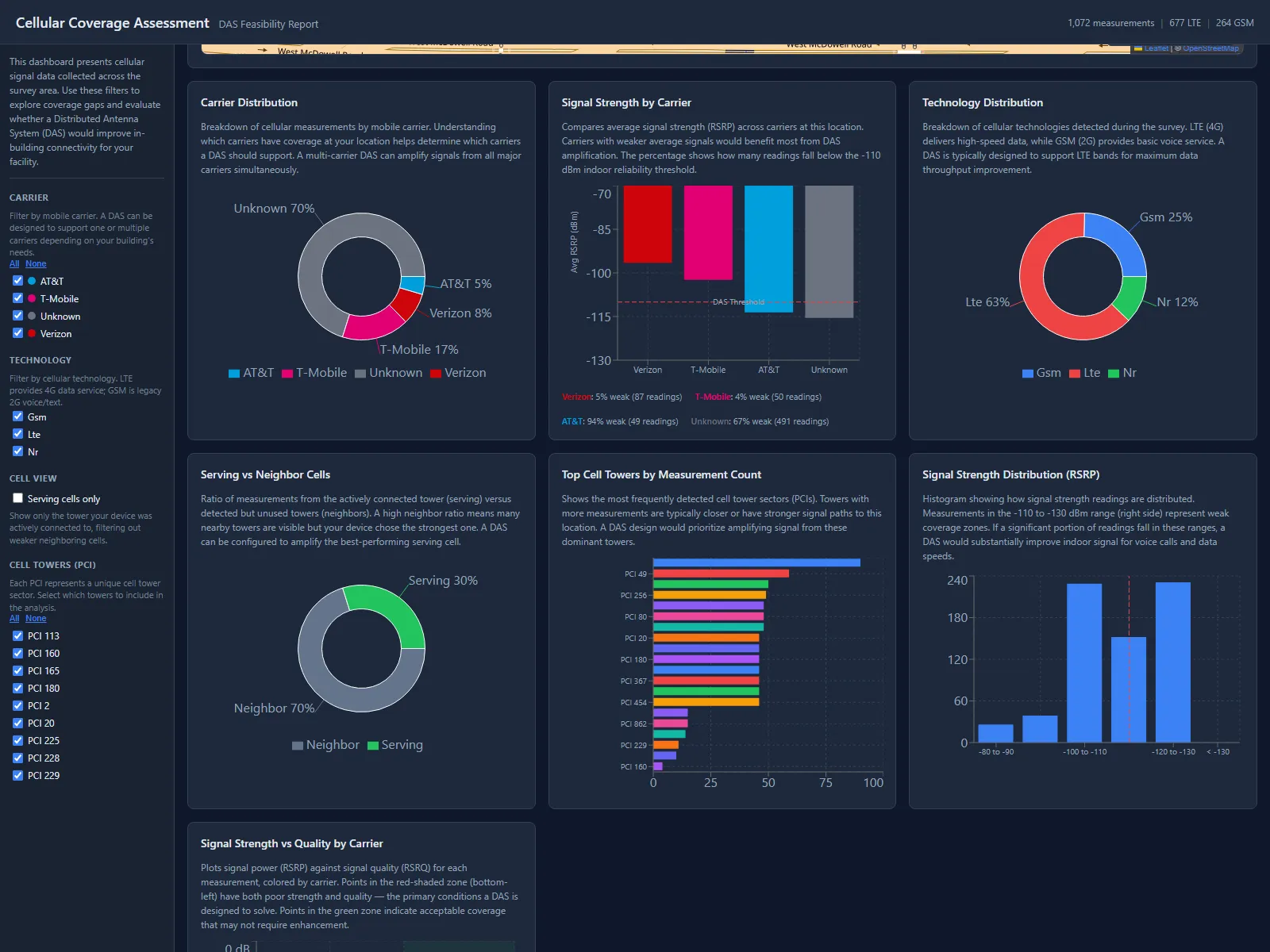
- Interactive dashboard with the baseline and verification passes side by side
- Summary report per site, ready for the carrier, integrator, or site owner
- Raw data export (CSV) for your own RF engineers
The dashboard is the same one we build for every survey; see custom signal dashboards for what it includes.
How a Baseline and Verification Survey Runs
The same steps work for a single node or a cluster.
- 1
Scope the sites
You send the pole or site list, the carriers in scope, and the area the node is meant to serve. We plan a route that covers the street and sidewalk level where the users are.
- 2
Baseline pass before activation
We survey the route on every carrier in scope and deliver the baseline maps, so the site case and the later comparison rest on the same data.
- 3
Key on the new node
The new node's PCI and cell ID come from your integrator or the carrier's commissioning sheet. They are what the footprint map is built on.
- 4
Verification pass after it is on air
Same route, similar time of day. A verification survey is only a comparison if the conditions match.
- 5
Deliver the before and after
Footprint, handoff edge, and the change in signal quality for each site, in the dashboard and the report, with the raw data alongside.
We Measure. Your Integrator Builds.
We are a measurement-only company: we do not design, sell, or install small cells, so the numbers are not written to favor one outcome. That matters most at verification, when the party that built the node should not be the only one saying it works. For how a small cell compares with the alternatives, see the DAS vs. small cell vs. booster guide.
Related Services and Guides
Onsite Signal Surveys
Indoor and outdoor grid surveys for DAS RFPs, coverage gaps, and post-installation validation.
Custom Signal Dashboards
Coverage heatmaps, carrier comparisons, and before-and-after views of your survey data.
DAS vs. Small Cell vs. Booster
How the three differ in capability, cost profile, and use case, and why a survey comes first.
Small Cell Survey FAQ
What is a small cell survey?
How do you confirm which small cell is serving?
Which carriers do you measure?
What do I receive?
Do you design or install small cells?
Planning a Small Cell Deployment?
Tell us about the sites and what you need to prove. We'll scope a baseline and verification survey.