
Airport & Transit Hub Signal Surveys
Onsite RF measurements for terminals, concourses, and transit stations — the empirical data behind high-capacity DAS, FirstNet, and public safety coverage.
Request a Survey QuoteAirports and transit hubs combine two of the hardest RF problems in one facility: enormous, structurally complex buildings and extreme, concentrated user demand. Tens of thousands of travelers stream data simultaneously across terminals, concourses, baggage halls, and below-grade rail platforms, while concrete, steel, and glass block the macro signal that might otherwise reach them. These environments almost always rely on neutral host DAS, and they carry stringent public safety communication requirements. A professional signal survey delivers the documented coverage and capacity baseline that integrators, authorities, and facility operators need.
RF Challenges in This Environment
The specific physical and operational conditions that make reliable cellular coverage hard in this kind of environment.
Peak-travel crowds generate some of the highest concentrated cellular data demand of any environment. Coverage alone is not enough — the survey must characterize conditions under real load.
Soaring terminal spaces with curtain-wall glass and long sightlines create complex propagation and inconsistent coverage that varies sharply across a single concourse.
Subterranean platforms, baggage handling, and tunnels receive essentially no macro signal and depend entirely on dedicated indoor infrastructure.
Metal jet bridges and gate areas exhibit sharp coverage cliffs that affect both passengers and operational staff at the busiest points in the terminal.
Airports and transit facilities are high-priority public safety environments where first-responder radio and FirstNet Band 14 coverage is mandatory and heavily scrutinized.
Why a Signal Survey Matters Here
In an airport, connectivity is operational infrastructure, not a convenience — airline apps, mobile boarding passes, ground crews, retail point-of-sale, and emergency communications all depend on it. A grid-based survey lays out the real coverage and capacity map for every carrier across every zone, identifies where service collapses under crowd load, and gives integrators the dataset to design a DAS that holds up on the busiest travel day, not just an empty-terminal walkthrough.
How We Survey This Environment
Methodology tailored to the realities of this environment.
- Grid survey across terminals, concourses, gates, baggage, ticketing, security queues, and below-grade rail or people-mover levels.
- Measurement under representative load where possible, with notes on crowd density and time-of-day conditions that affect capacity.
- Carrier-by-carrier capture of RSRP, RSRQ, SINR, RSSI, PCI, and serving technology across all major carriers plus FirstNet Band 14.
- Dedicated public safety band measurement for ERRCS and first-responder coverage, coordinated with the AHJ's thresholds.
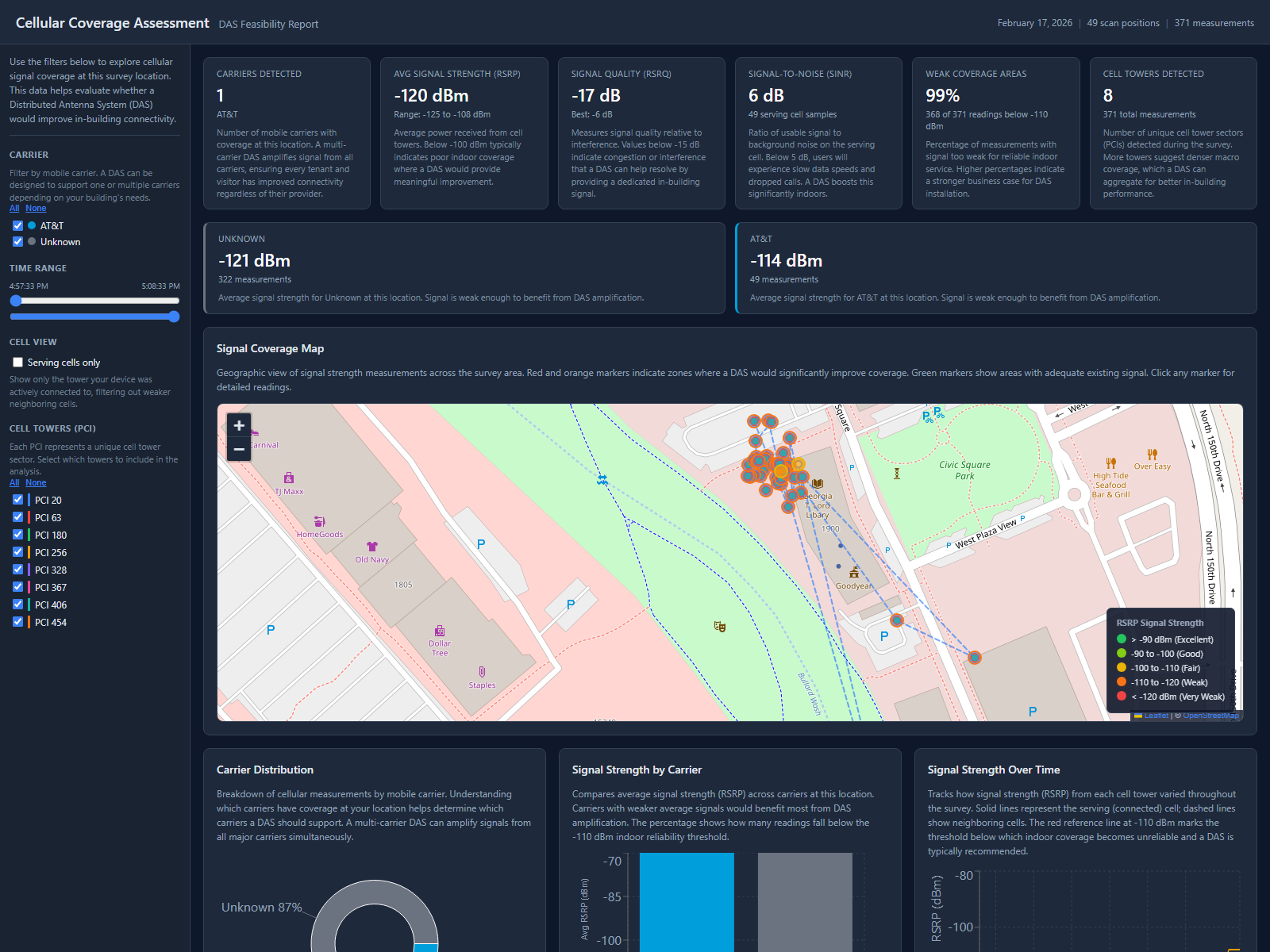
- Deliverables include heatmaps on terminal floor plans, dead-zone and weak-capacity zone lists, and an interactive dashboard for operations, IT, and public safety stakeholders.
Common Use Cases
Terminal expansion DAS planning
Document baseline coverage before a concourse or terminal expansion so the DAS design reflects real conditions and capacity needs.
Public safety / FirstNet compliance
Verify in-building radio and FirstNet coverage for first responders across the facility under NFPA 1225 and local AHJ requirements.
Capacity assessment for peak travel
Quantify where coverage holds but capacity fails under crowd load, guiding capacity-focused DAS or small-cell augmentation.
Post-installation validation
Confirm a new neutral host DAS meets contracted coverage and capacity targets across the terminal after commissioning.
Compliance & Regulatory Notes
Airports and transit facilities are typically subject to NFPA 1225 / IFC 510 in-building radio requirements and elevated public safety expectations. Our reports document FirstNet Band 14 and public safety band coverage, Delivered Audio Quality (DAQ), and Tier 1 cellular coverage in a single AHJ-ready deliverable.
Related
Onsite Signal Surveys
Our core measurement service — multi-carrier RF data captured across your facility.
Custom Signal Dashboards
Interactive heatmaps, carrier comparisons, and compliance scoring built from your survey data.
What Is a DAS Signal Survey?
The complete guide to signal surveys, what gets measured, and how results inform DAS design.
Surveys in Similar Facilities
Hospitals & Healthcare
Cellular signal surveys for hospitals and healthcare campuses. RSRP, RSRQ, and SINR measurements for DAS planning, ERRCS compliance, and clinical comms.
Warehouses & Distribution
Onsite RF surveys for warehouses, fulfillment centers, and distribution hubs. Measure RSRP, RSRQ, and SINR for scanner connectivity, IoT, and DAS planning.
Office Towers
Cellular signal surveys for Class-A office towers and high-rises. RSRP, RSRQ, and SINR measurements for DAS planning, tenant coverage, and ERRCS.
Background Reading
Why Cell Signal Drops Indoors
Why cellular signal weakens indoors, how building materials affect coverage, and what DAS and a professional signal survey can do about it.
EV Charger Cellular Signal Survey Guide
Why EV chargers depend on cellular signal, what a charger site survey measures, the signal levels that matter, and what to do when a site comes up short.
Digital Billboard Signal Survey Guide
Why digital billboards depend on cellular signal, what a billboard site survey measures, the signal levels that matter, and what to do when a site comes up short.
Airports & Transit Survey FAQ
Can you measure coverage under real passenger load instead of an empty terminal?
Do you handle secure and airside areas?
Do you measure FirstNet and public safety radio coverage?
How long does an airport survey take?
Request a Airports & Transit Signal Survey
Tell us about your facility and coverage goals. We'll provide a detailed proposal with scope, timeline, and pricing.