
Parking Structure & Below-Grade Signal Surveys
Onsite RF measurements for parking garages and subterranean levels — the data behind reliable coverage for drivers, EV charging, IoT, and public safety.
Request a Survey QuoteParking structures are among the most predictably dead zones in any building. Reinforced concrete decks stacked floor over floor, and below-grade levels surrounded by earth, block nearly all outdoor cellular signal. As parking integrates EV charging, license-plate and payment systems, wayfinding apps, and cellular-backhauled IoT, those dead zones translate into failed transactions and frustrated drivers — and stairwells and elevators carry public safety coverage requirements. A professional signal survey delivers the documented coverage map needed to plan a DAS or repeater system that actually works underground.
RF Challenges in This Environment
The specific physical and operational conditions that make reliable cellular coverage hard in this kind of environment.
Each concrete parking deck attenuates signal further, so coverage degrades rapidly as drivers descend from the top level toward grade and below.
Levels surrounded by earth and structure receive essentially no macro signal and depend entirely on dedicated indoor infrastructure or a repeater fed from a usable donor.
Coverage falls off a cliff as a vehicle moves from the open entry ramp (with line of sight to outdoor towers) deeper into the structure, causing dropped connections at gates and payment points.
Enclosed vertical circulation is RF-hostile and frequently subject to ERRCS public safety coverage requirements for first responders.
Modern garages depend on cellular-backhauled EV chargers, payment kiosks, sensors, and cameras that fail silently in dead zones, often blamed on the equipment rather than coverage.
Why a Signal Survey Matters Here
A parking structure with no signal is a daily friction point — drivers cannot pay by app, cannot find their way out, and lose connectivity the moment they pull in, while EV chargers and payment systems fail in ways that are hard to diagnose. A survey replaces guesswork with a level-by-level coverage map for each carrier, characterizes whether any usable donor signal exists at the structure, and gives integrators the data to choose between a DAS, a repeater system, or a hybrid — and to size it correctly.
How We Survey This Environment
Methodology tailored to the realities of this environment.
- Level-by-level grid survey from the top deck to the lowest below-grade level, with tighter density at entries, ramps, gates, payment points, and EV charging zones.
- Dedicated measurement of stairwells and elevators for ERRCS and public safety coverage.
- Rooftop and perimeter donor signal characterization to determine whether a repeater is viable or a carrier-fed DAS is required.
- Carrier-by-carrier capture of RSRP, RSRQ, SINR, RSSI, PCI, and serving technology across all major carriers plus FirstNet Band 14 where required.
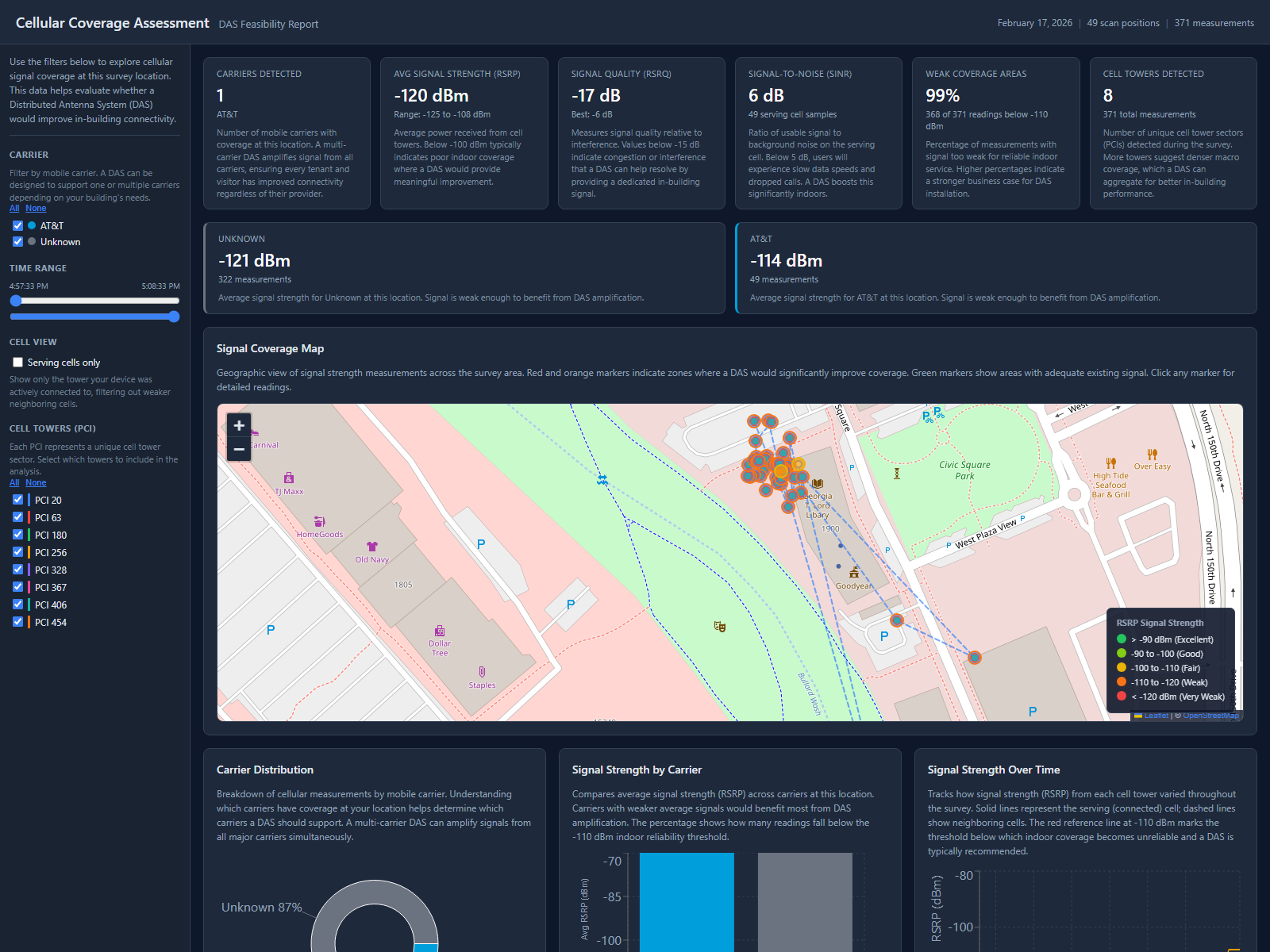
- Deliverables include heatmaps on garage plans, dead-zone lists by level, donor-signal findings, and an interactive dashboard for facility and integrator review.
Common Use Cases
Standalone garage coverage planning
Document coverage and donor conditions to size a DAS or repeater system for a parking structure that performs on every level.
Mixed-use podium parking
Characterize below-grade and podium parking as part of a larger office, residential, or hospitality DAS project.
Public safety compliance
Document first-responder radio coverage in stairwells, elevators, and parking levels under NFPA 1225 and IFC 510.
EV and IoT connectivity diagnosis
Pinpoint the dead zones causing EV charger, payment, and sensor failures so the right coverage solution can be specified.
Compliance & Regulatory Notes
Parking structures are commonly subject to ERRCS public safety radio coverage requirements under NFPA 1225 and IFC 510, particularly in stairwells, elevator lobbies, and below-grade levels. Our reports document public safety band coverage and Delivered Audio Quality (DAQ) alongside Tier 1 cellular coverage.
Related
Onsite Signal Surveys
Our core measurement service — multi-carrier RF data captured across your facility.
Custom Signal Dashboards
Interactive heatmaps, carrier comparisons, and compliance scoring built from your survey data.
What Is a DAS Signal Survey?
The complete guide to signal surveys, what gets measured, and how results inform DAS design.
Surveys in Similar Facilities
Hospitals & Healthcare
Cellular signal surveys for hospitals and healthcare campuses. RSRP, RSRQ, and SINR measurements for DAS planning, ERRCS compliance, and clinical comms.
Warehouses & Distribution
Onsite RF surveys for warehouses, fulfillment centers, and distribution hubs. Measure RSRP, RSRQ, and SINR for scanner connectivity, IoT, and DAS planning.
Office Towers
Cellular signal surveys for Class-A office towers and high-rises. RSRP, RSRQ, and SINR measurements for DAS planning, tenant coverage, and ERRCS.
Background Reading
Why Cell Signal Drops Indoors
Why cellular signal weakens indoors, how building materials affect coverage, and what DAS and a professional signal survey can do about it.
EV Charger Cellular Signal Survey Guide
Why EV chargers depend on cellular signal, what a charger site survey measures, the signal levels that matter, and what to do when a site comes up short.
Digital Billboard Signal Survey Guide
Why digital billboards depend on cellular signal, what a billboard site survey measures, the signal levels that matter, and what to do when a site comes up short.
Parking Structures Survey FAQ
Is there any way to get coverage on the lowest below-grade level?
Will a signal booster fix our garage?
Do you cover EV charging and payment-point zones specifically?
Do parking structures really need public safety coverage?
Request a Parking Structures Signal Survey
Tell us about your facility and coverage goals. We'll provide a detailed proposal with scope, timeline, and pricing.