
Office Tower & High-Rise Signal Surveys
Real-world RF measurements for Class-A office towers and commercial high-rises — supporting DAS planning, tenant coverage commitments, and ERRCS compliance.
Request a Survey QuoteModern office towers are some of the worst-performing buildings for indoor cellular coverage, and it is usually the building's own design that causes it. Floor-to-ceiling Low-E glass curtain walls, reinforced concrete cores, and deep floor plates combine to block outdoor macro signal before it reaches a tenant's desk. As leases increasingly hinge on connectivity and tenants run business-critical workflows over cellular, weak coverage becomes a leasing and retention liability. A professional signal survey produces the documented baseline that DAS integrators, landlords, and property managers need to plan effective in-building coverage.
RF Challenges in This Environment
The specific physical and operational conditions that make reliable cellular coverage hard in this kind of environment.
The energy-efficient glazing that defines Class-A towers carries metallic coatings that attenuate cellular signal by 20–40 dB, turning the building envelope into a near-Faraday cage.
Central elevator and stair cores are built from heavy structural concrete and rebar, casting deep RF shadows across the interior of every floor.
Outdoor signal that does penetrate the facade fades quickly toward the building core. Window offices may show acceptable coverage while interior conference rooms and corridors register dead zones.
Steel-lined elevator cabs and shafts are effectively opaque to cellular signal — a common complaint zone and a frequent ERRCS requirement for first-responder communications.
Subterranean and podium parking, loading docks, and back-of-house levels sit below grade where macro signal does not reach, creating sharp coverage cliffs at building entries.
Why a Signal Survey Matters Here
For a landlord, poor cellular coverage is a leasing problem. Tenants increasingly write connectivity expectations into letters of intent, and a tower that drops calls in conference rooms is a tower that loses tenants at renewal. A signal survey converts vague complaints — 'service is terrible above the 30th floor' — into a quantified, floor-by-floor, carrier-by-carrier record of where coverage fails and by how much, giving ownership the evidence to justify a DAS investment and the baseline to hold an integrator to measurable targets.
How We Survey This Environment
Methodology tailored to the realities of this environment.
- Floor-by-floor grid survey of tenant floors, lobbies, amenity levels, and common areas, with tighter density in interior zones farthest from the facade.
- Dedicated measurement of stairwells, elevator banks, parking levels, and loading docks for ERRCS and commercial coverage.
- Carrier-by-carrier capture of RSRP, RSRQ, SINR, RSSI, PCI, and serving technology across AT&T, Verizon, T-Mobile, and FirstNet Band 14.
- Outdoor perimeter and rooftop donor readings to characterize the macro signal available to feed a potential DAS or BDA.
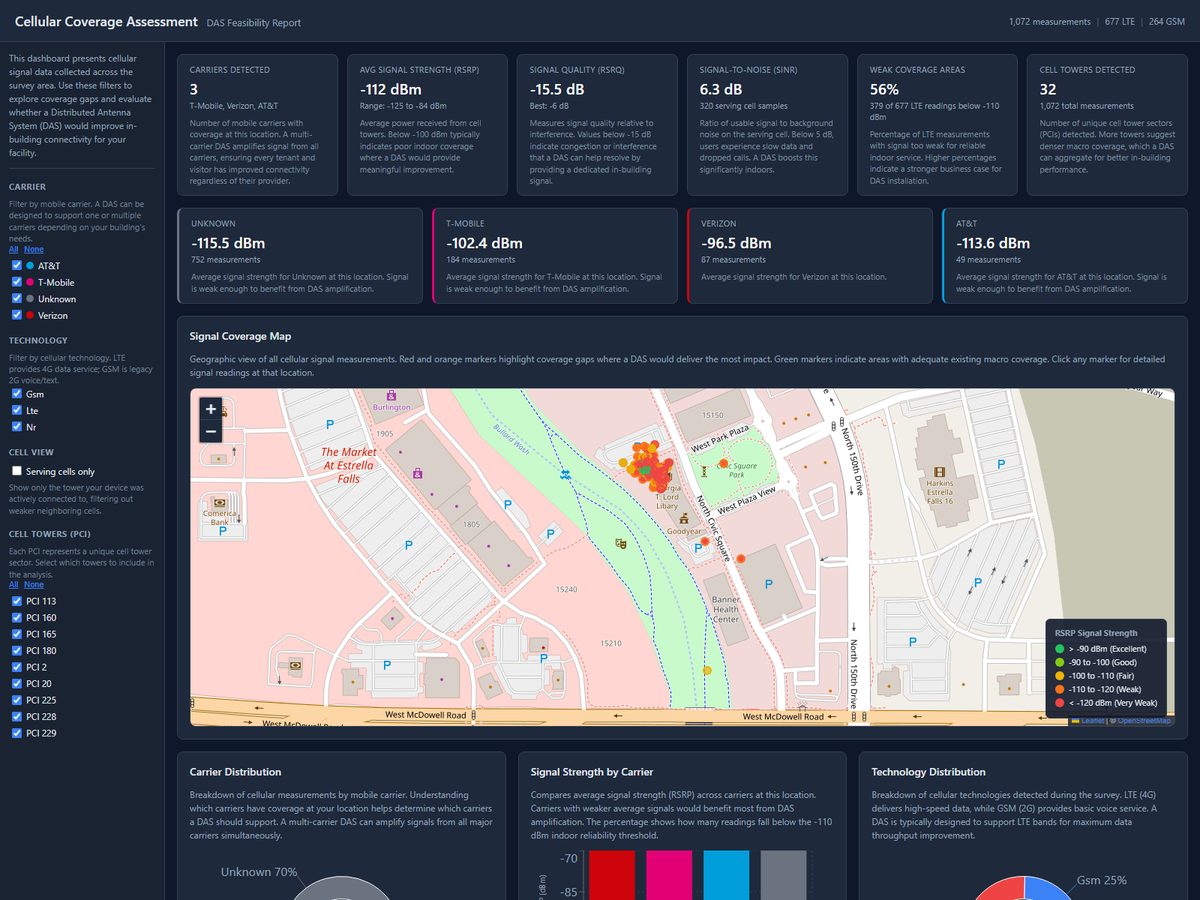
- Deliverables include heatmaps overlaid on floor plans, compliance scoring against AHJ thresholds, and an interactive dashboard for ownership, property management, and prospective tenants.
Common Use Cases
DAS RFP preparation for new or repositioned towers
Establish a documented baseline so DAS designs reflect the building's actual signal environment rather than theoretical propagation models.
Tenant retention and lease-up
Give leasing teams measured coverage data to address tenant connectivity concerns before they become renewal risks.
ERRCS / public safety compliance
Document in-building radio coverage for first responders under NFPA 1225 and IFC 510 ahead of AHJ inspection.
Post-installation validation
Verify that a new neutral host DAS meets contracted RSRP and SINR thresholds across all occupied floors after commissioning.
Compliance & Regulatory Notes
High-rise office buildings frequently must demonstrate compliance with NFPA 1225 (in-building radio coverage) and IFC 510, particularly for stairwells, elevator lobbies, and fire command centers. Our reports document public safety band coverage and Delivered Audio Quality (DAQ) alongside Tier 1 cellular coverage in a single deliverable.
Related
Onsite Signal Surveys
Our core measurement service — multi-carrier RF data captured across your facility.
Custom Signal Dashboards
Interactive heatmaps, carrier comparisons, and compliance scoring built from your survey data.
What Is a DAS Signal Survey?
The complete guide to signal surveys, what gets measured, and how results inform DAS design.
Surveys in Similar Facilities
Hospitals & Healthcare
Cellular signal surveys for hospitals and healthcare campuses. RSRP, RSRQ, and SINR measurements for DAS planning, ERRCS compliance, and clinical comms.
Warehouses & Distribution
Onsite RF surveys for warehouses, fulfillment centers, and distribution hubs. Measure RSRP, RSRQ, and SINR for scanner connectivity, IoT, and DAS planning.
Airports & Transit
Onsite cellular signal surveys for airports, terminals, and transit hubs. RSRP, RSRQ, and SINR for high-capacity DAS, FirstNet, and public safety.
Background Reading
What a DAS Signal Survey Measures
What a DAS signal survey measures (RSRP, RSRQ, SINR), when you need one, and how the data drives DAS RFPs and post-install validation.
Why Cell Signal Drops Indoors
Why cellular signal weakens indoors, how building materials affect coverage, and what DAS and a professional signal survey can do about it.
EV Charger Cellular Signal Survey Guide
Why EV chargers depend on cellular signal, what a charger site survey measures, the signal levels that matter, and what to do when a site comes up short.
Office Towers Survey FAQ
Why does our brand-new tower have worse coverage than the old building we left?
Can you survey occupied tenant floors without disruption?
Do you measure coverage in the parking garage and elevators?
Will the survey tell us which carriers need a DAS?
Request a Office Towers Signal Survey
Tell us about your facility and coverage goals. We'll provide a detailed proposal with scope, timeline, and pricing.