
Onsite DAS & Cellular Signal Surveys
Precise RF measurements for DAS RFPs, DAS testing, coverage validation, and indoor optimization. We measure what matters—inside your building, on every floor, across every carrier.
What We Measure
Comprehensive RF metrics captured at every test point across your facility.
Primary indicator of signal strength from each cell tower
Measures signal quality relative to interference
Key metric for data throughput potential
Overall signal power across the channel
Which carriers and physical cell IDs serve each location
5G NR, LTE, UMTS, and GSM detection at every test point
Precise location tagging for every measurement
Exact timing for temporal analysis and reporting
Survey Types
Tailored survey approaches for every facility and project requirement.
Systematic floor-by-floor measurement grid covering all occupied areas, common spaces, and critical zones like elevators and stairwells.
Signal measurements around the building exterior to establish macro coverage baseline and identify the best serving sectors for each carrier.
Comprehensive vertical survey capturing floor-to-floor signal variation, elevator coverage, and stairwell connectivity across the entire building.
Comparison measurements that validate or challenge existing drive test data with actual indoor measurements at the point of use.
What You Receive
Every survey includes a comprehensive deliverables package designed for actionable decision-making.
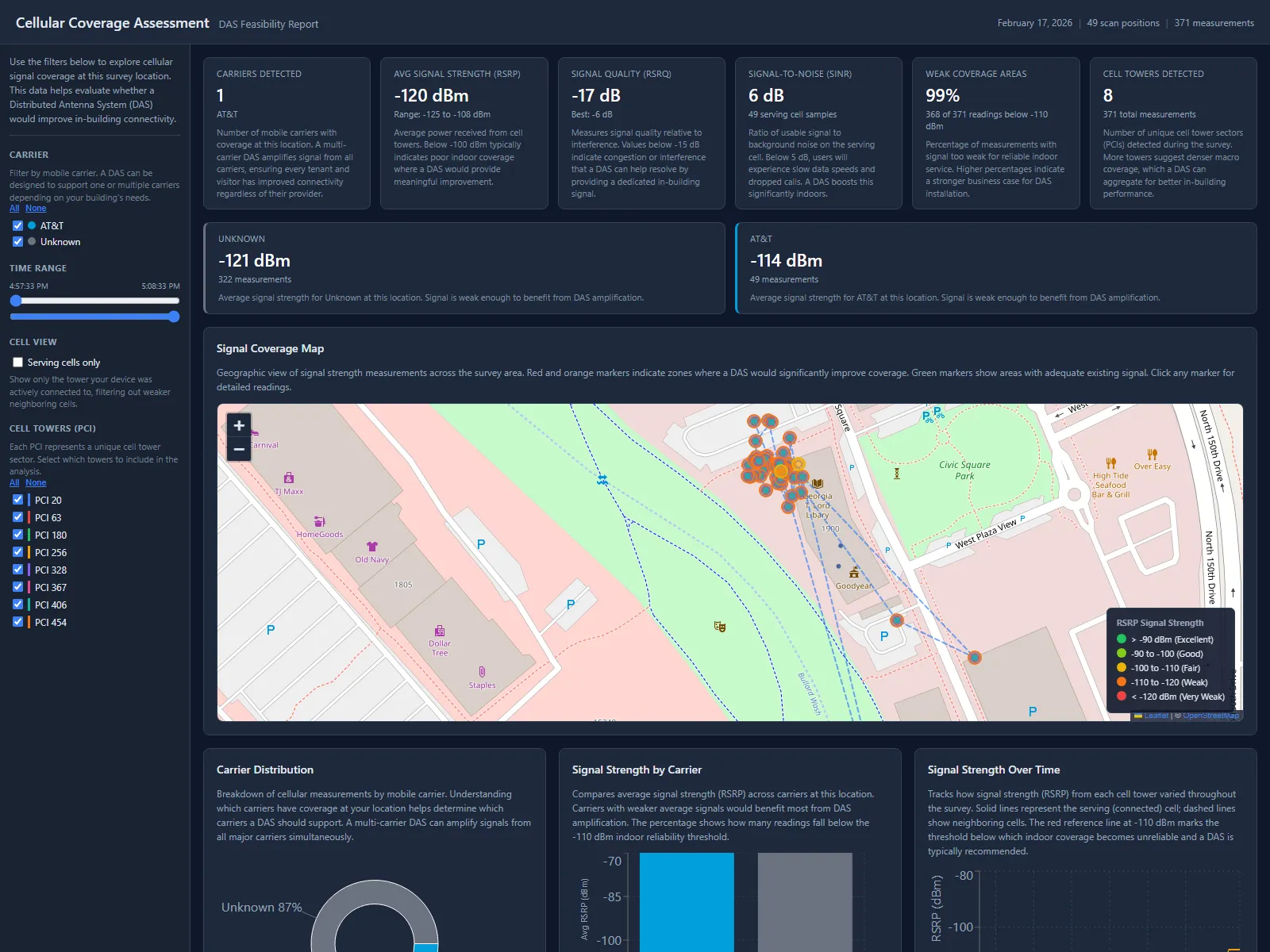
- Coverage heatmaps overlaid on floor plans
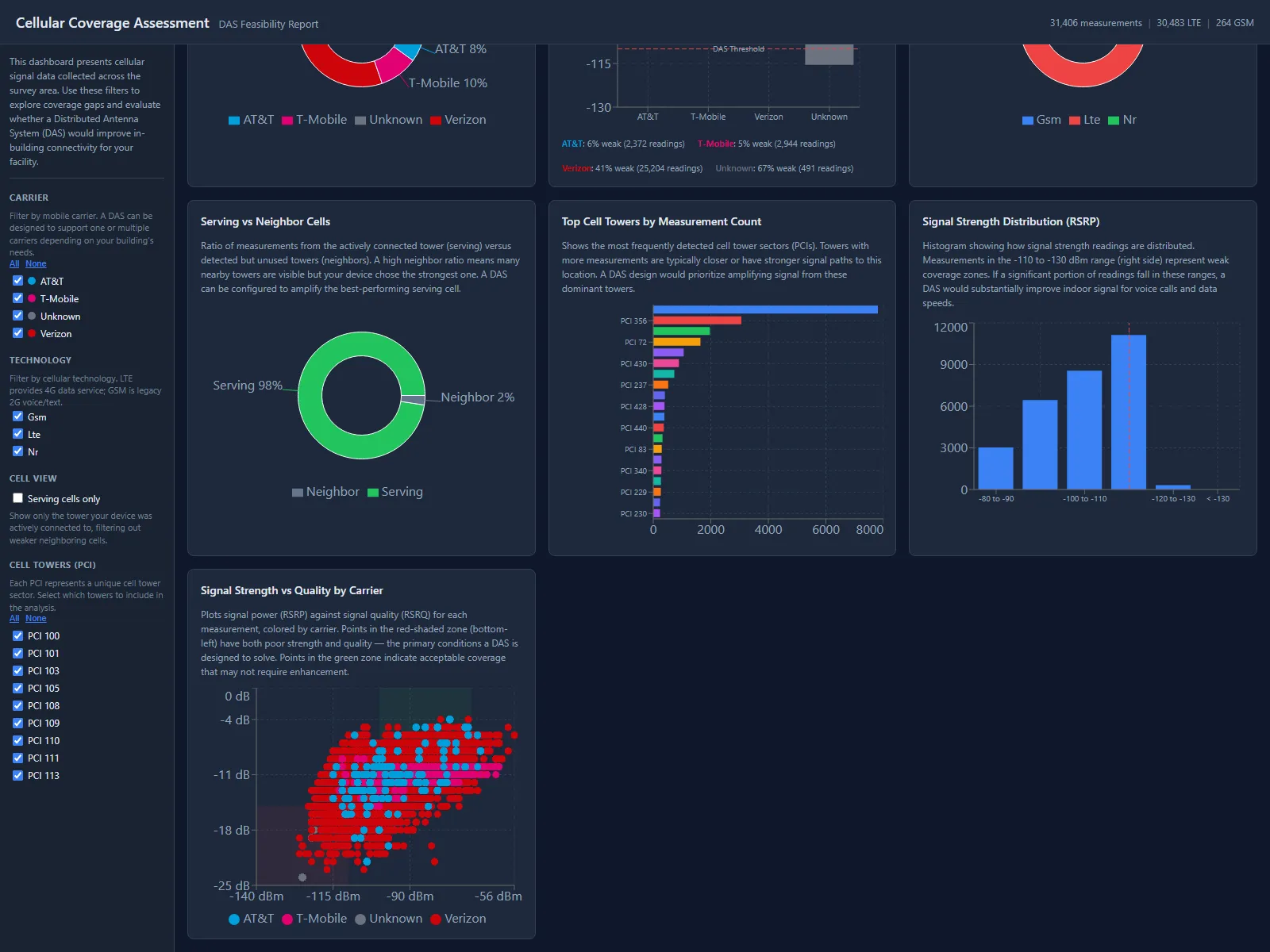
- Signal strength distribution charts by carrier
- Carrier comparison tables and rankings
- PCI and serving cell analysis
- DAS compliance scoring against industry thresholds
- Executive summary with key findings and recommendations
- Raw data export (CSV) for independent analysis
Use Cases
Our surveys support a wide range of connectivity and infrastructure projects.
DAS RFP Preparation
Provide DAS integrators with the baseline coverage data they need to design effective systems.
Post-Installation Validation
Verify that DAS installation meets performance requirements with before-and-after comparison data.
Lease Negotiation Support
Document coverage quality for lease agreements, tenant improvement negotiations, and building certifications.
Coverage Gap Analysis
Identify and quantify coverage gaps, dead zones, and weak areas that affect occupant connectivity.
Real-Time Measurement Capture
Signal data is captured in real time as technicians move through your facility. Every measurement is GPS-tagged, timestamped, and checked for quality while we are still on site, so gaps get re-measured before we leave. No black boxes, no guesswork — just transparent, verifiable data.
How the Survey Is Actually Run
Two surveys of the same building can produce completely different numbers. Methodology is the reason, so here is ours.
A grid, not a wander
Test points are laid out on a grid across each floor rather than chosen by where signal happens to look interesting. Spacing tightens in the areas that matter most — stairwells, elevator lobbies, riser closets, below-grade levels, and anywhere a fire alarm or emergency communications panel sits — and opens up across uniform open-plan space. The result is a dataset that can be honestly compared against a later re-survey, because the second pass walks the same grid.
Every carrier, at the same point, at the same time
At each test point we capture all available carriers simultaneously rather than walking the building once per carrier. This matters more than it sounds: carrier coverage differs floor by floor in the same building, and sequential single-carrier passes introduce time as a variable — network load at 9am is not network load at 4pm. Capturing together means a carrier comparison is a real comparison.
Measured at the height a phone is actually used
Readings are taken at roughly hand height, standing, in the spaces people occupy. That is a deliberate departure from a rooftop or drive-test methodology, which measures where the equipment is convenient rather than where the problem is. Building penetration loss, internal partition loss, elevator shielding and floor-to-floor variation only show up when you measure inside, and they are usually the entire reason coverage is failing.
Under real conditions, not empty-building conditions
We survey during normal business hours whenever access allows. Surveying an empty building on a Sunday produces flattering numbers and a system sized for a load that never occurs. Where occupancy varies dramatically — a stadium, a lecture hall, a terminal at departure peak — we scope the survey around the conditions the system actually has to survive.
Donor signal is measured too
Indoor readings alone cannot tell an integrator whether a passive DAS is viable. Rooftop and exterior donor readings establish what signal is available to bring inside in the first place, which is the difference between a system that can be fed off-air and one that needs a small cell or an operator agreement. Skipping this is a common way for a survey to be technically accurate and still useless at design time.
Where a project is driven by code rather than by user complaints, the survey is scoped against the standard in question instead — see the NFPA 1225 ERRCS survey guide for how a public-safety pass differs from a commercial one.
Related Resources
Deepen your understanding of signal surveys and indoor RF coverage.
What Is a DAS Signal Survey?
A complete guide to DAS signal surveys, what gets measured, and how results inform system design.
Why Signal Drops Indoors
How building materials, construction types, and frequency bands affect indoor cellular coverage.
Custom Signal Dashboards
See how your survey data transforms into interactive heatmaps, charts, and compliance reports.
Signal Survey FAQ
How do I get started with a signal survey?
What information do I need to provide before the survey?
What property access do you require?
Why do renovations affect survey results?
Do you handle public safety and ERRCS requirements?
What happens after the survey is completed?
How is your survey different from a drive test?
Request a Survey Quote
Tell us about your facility and coverage goals. We'll provide a detailed proposal with scope, timeline, and pricing.