
Higher-Education Campus Signal Surveys
Real-world RF measurements across lecture halls, residence halls, labs, and athletics — supporting campus DAS planning, capacity, and public safety coverage.
Request a Survey QuoteA university campus is not one building but dozens, spanning a century of construction styles and a wide range of RF behavior. Dense lecture halls demand capacity, residence halls demand reliable everyday coverage, labs and basements block signal, and the whole campus carries public safety obligations. Students, faculty, and staff treat connectivity as a baseline expectation, and admissions increasingly compete on it. A professional signal survey produces the documented, building-by-building baseline that campus facilities, IT, and DAS integrators need to prioritize and plan coverage investment.
RF Challenges in This Environment
The specific physical and operational conditions that make reliable cellular coverage hard in this kind of environment.
Campuses span historic masonry buildings and modern Low-E glass-and-concrete structures, producing wildly different coverage behavior from one building to the next.
Large lecture halls and auditoriums concentrate hundreds of devices in one room, creating capacity demand that coverage-only assessments miss.
Dormitories combine concrete construction, dense occupancy, and round-the-clock usage where reliable coverage is a constant student expectation.
Research labs, shielded rooms, and below-grade levels are RF-hostile zones where coverage routinely fails and where research equipment can introduce interference.
Coverage must be characterized across a large campus with transitions between buildings, outdoor quads, parking, and athletics facilities.
Why a Signal Survey Matters Here
On a campus, connectivity touches recruitment, safety, and daily academic life. Prospective students notice dead zones on tours, faculty depend on connected classrooms, and campus safety relies on reliable communications. A building-by-building survey maps coverage and capacity for each carrier across academic, residential, and athletic facilities, identifies which buildings most need intervention, and gives facilities and integrators a prioritized, data-backed plan rather than reacting to the loudest complaints.
How We Survey This Environment
Methodology tailored to the realities of this environment.
- Building-by-building grid survey across academic halls, residence halls, libraries, labs, student centers, and athletics facilities, prioritized by occupancy and complaint history.
- Tighter test-point density in high-density lecture halls and auditoriums to characterize capacity, not just coverage.
- Dedicated measurement of stairwells, basements, and labs for public safety coverage and known interference sources.
- Carrier-by-carrier capture of RSRP, RSRQ, SINR, RSSI, PCI, and serving technology across all major carriers plus FirstNet Band 14.
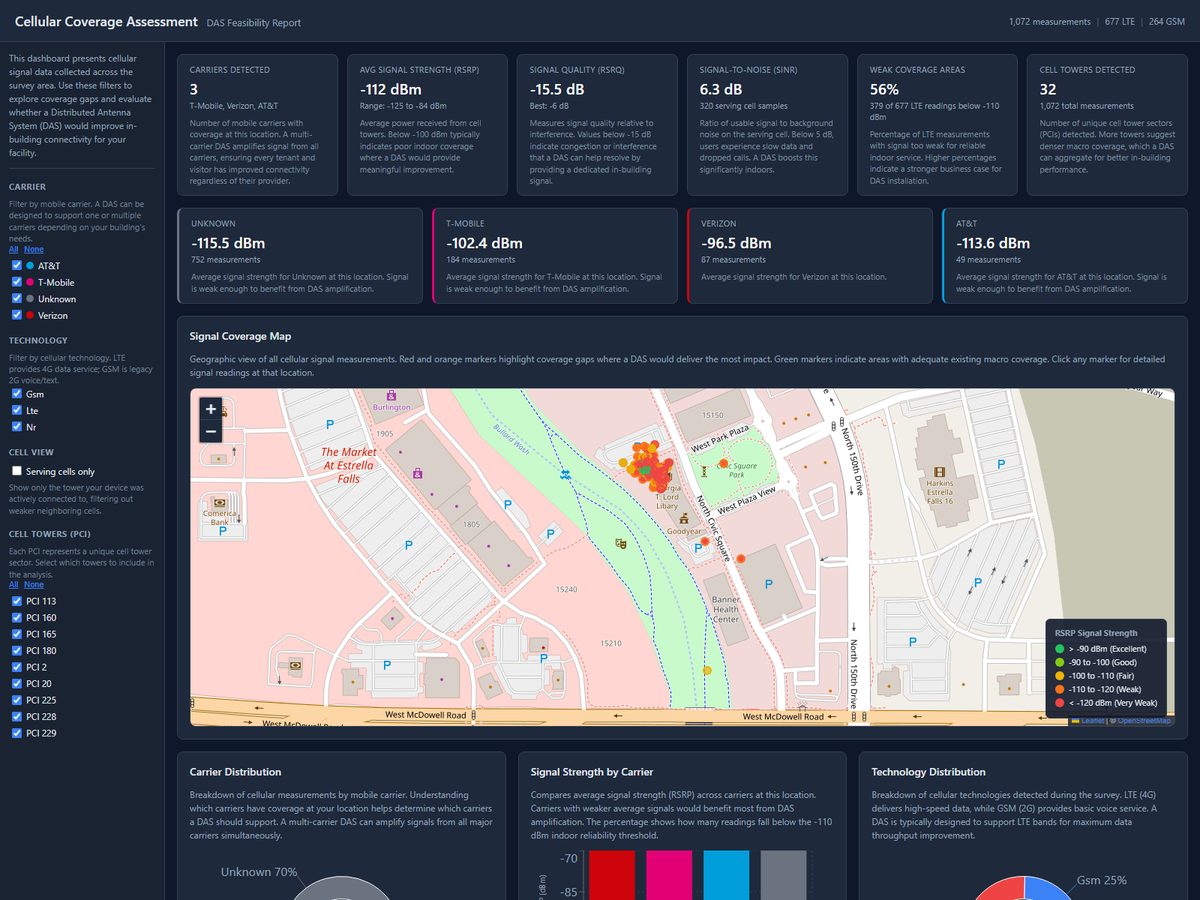
- Deliverables include per-building heatmaps, a campus-wide priority ranking of coverage gaps, and an interactive dashboard for facilities, IT, and public safety stakeholders.
Common Use Cases
Campus-wide coverage assessment
Establish a building-by-building baseline to prioritize which facilities most need DAS or coverage investment across a large campus.
Residence hall coverage
Quantify and document coverage in dormitories where reliable connectivity is a constant student-experience expectation.
Lecture hall capacity planning
Characterize capacity in high-density classrooms and auditoriums to guide DAS or small-cell augmentation.
Public safety / FirstNet compliance
Document first-responder radio coverage across campus buildings under NFPA 1225 and local AHJ requirements.
Compliance & Regulatory Notes
Campus buildings are frequently subject to NFPA 1225 / IFC 510 in-building radio requirements, and many institutions coordinate closely with campus and municipal public safety agencies. Our reports document FirstNet Band 14 and public safety band coverage, Delivered Audio Quality (DAQ), and Tier 1 cellular coverage building by building.
Related
Onsite Signal Surveys
Our core measurement service — multi-carrier RF data captured across your facility.
Custom Signal Dashboards
Interactive heatmaps, carrier comparisons, and compliance scoring built from your survey data.
What Is a DAS Signal Survey?
The complete guide to signal surveys, what gets measured, and how results inform DAS design.
Surveys in Similar Facilities
Hospitals & Healthcare
Cellular signal surveys for hospitals and healthcare campuses. RSRP, RSRQ, and SINR measurements for DAS planning, ERRCS compliance, and clinical comms.
Warehouses & Distribution
Onsite RF surveys for warehouses, fulfillment centers, and distribution hubs. Measure RSRP, RSRQ, and SINR for scanner connectivity, IoT, and DAS planning.
Office Towers
Cellular signal surveys for Class-A office towers and high-rises. RSRP, RSRQ, and SINR measurements for DAS planning, tenant coverage, and ERRCS.
Background Reading
What a DAS Signal Survey Measures
What a DAS signal survey measures (RSRP, RSRQ, SINR), when you need one, and how the data drives DAS RFPs and post-install validation.
Why Cell Signal Drops Indoors
Why cellular signal weakens indoors, how building materials affect coverage, and what DAS and a professional signal survey can do about it.
EV Charger Cellular Signal Survey Guide
Why EV chargers depend on cellular signal, what a charger site survey measures, the signal levels that matter, and what to do when a site comes up short.
Higher-Ed Campuses Survey FAQ
Do we need to survey every building on campus?
Can you survey residence halls without disturbing students?
Is our classroom problem coverage or capacity?
Do you measure public safety radio coverage on campus?
Request a Higher-Ed Campuses Signal Survey
Tell us about your facility and coverage goals. We'll provide a detailed proposal with scope, timeline, and pricing.