
Hotel & Hospitality Signal Surveys
Onsite RF measurements for hotels, resorts, and conference centers — the empirical data behind guest-experience coverage, event-space capacity, and DAS investment.
Request a Survey QuoteFor a hotel, cellular coverage is part of the guest experience, and guests are quick to mention dead zones in reviews. Guest-room towers built from concrete and Low-E glass block signal, ballrooms and conference centers demand capacity during events, and back-of-house and below-grade levels routinely fail. Brand standards and meeting-planner expectations increasingly require demonstrable connectivity. A professional signal survey delivers the documented coverage and capacity baseline that ownership, brand teams, and DAS integrators need to protect guest satisfaction and event revenue.
RF Challenges in This Environment
The specific physical and operational conditions that make reliable cellular coverage hard in this kind of environment.
Stacked guest-room floors built from concrete and Low-E glass attenuate signal heavily, leaving interior rooms and higher floors with weak or no coverage.
Large event spaces concentrate hundreds or thousands of attendees, creating capacity demand that empty-building assessments completely miss.
Energy-efficient glazing on newer properties carries metallic coatings that block 20–40 dB of cellular signal, a leading cause of poor in-room coverage.
Kitchens, laundry, loading docks, and subterranean parking and mechanical levels are RF-hostile zones affecting both staff operations and guest parking.
Multi-building resorts spread coverage across towers, villas, amenities, and outdoor areas, with sharp transitions and large areas to characterize.
Why a Signal Survey Matters Here
In hospitality, a dropped call in a guest room or a saturated network during a conference shows up directly in reviews, meeting-planner feedback, and repeat bookings. A survey converts those anecdotes into a quantified, floor-by-floor and space-by-space coverage and capacity map for every carrier, identifies where the property fails guests and event clients, and gives ownership and brand teams the evidence to justify a DAS and the baseline to verify it after installation.
How We Survey This Environment
Methodology tailored to the realities of this environment.
- Grid survey across guest-room floors, lobbies, ballrooms, conference space, restaurants, amenities, and back-of-house, with representative room sampling.
- Tighter test-point density and load-aware measurement in ballrooms and meeting space where event capacity is the concern.
- Carrier-by-carrier capture of RSRP, RSRQ, SINR, RSSI, PCI, and serving technology across all major carriers plus FirstNet Band 14 where required.
- Measurement of parking, stairwells, and below-grade levels for public safety coverage and guest convenience.
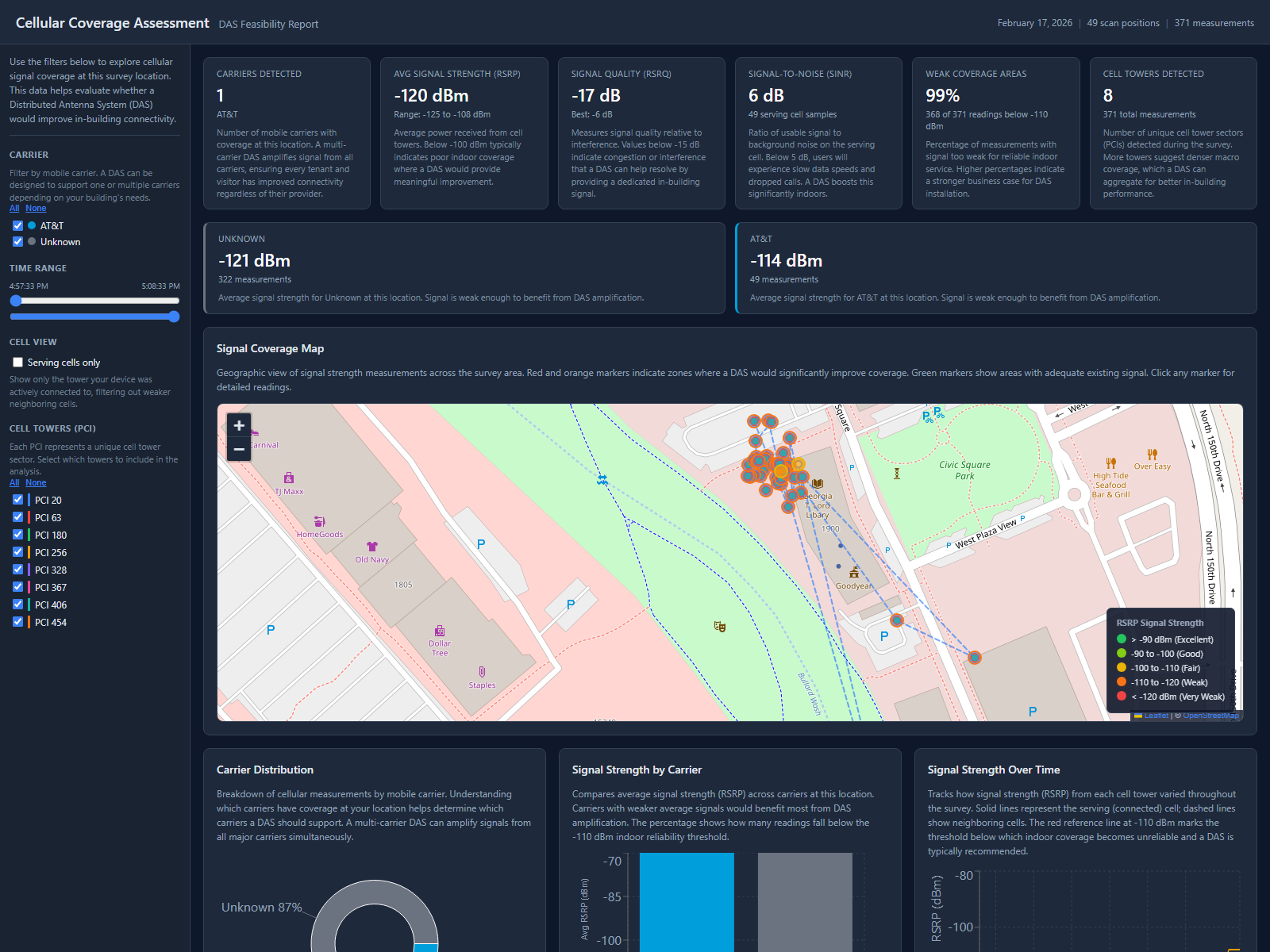
- Deliverables include heatmaps on property floor plans, dead-zone and capacity-constrained zone lists, and an interactive dashboard for ownership, brand, and integrator review.
Common Use Cases
Guest-experience coverage assessment
Quantify and document in-room and amenity coverage gaps that affect guest satisfaction and online reviews.
Conference and event capacity
Characterize capacity in ballrooms and meeting space to meet event-client expectations and guide DAS or small-cell augmentation.
Brand-standard and DAS RFP support
Provide the baseline data needed to meet brand connectivity standards and to scope a DAS investment with integrators.
Post-installation validation
Confirm a new DAS meets coverage and capacity targets across guest rooms and event space after commissioning.
Related
Onsite Signal Surveys
Our core measurement service — multi-carrier RF data captured across your facility.
Custom Signal Dashboards
Interactive heatmaps, carrier comparisons, and compliance scoring built from your survey data.
What Is a DAS Signal Survey?
The complete guide to signal surveys, what gets measured, and how results inform DAS design.
Surveys in Similar Facilities
Hospitals & Healthcare
Cellular signal surveys for hospitals and healthcare campuses. RSRP, RSRQ, and SINR measurements for DAS planning, ERRCS compliance, and clinical comms.
Warehouses & Distribution
Onsite RF surveys for warehouses, fulfillment centers, and distribution hubs. Measure RSRP, RSRQ, and SINR for scanner connectivity, IoT, and DAS planning.
Office Towers
Cellular signal surveys for Class-A office towers and high-rises. RSRP, RSRQ, and SINR measurements for DAS planning, tenant coverage, and ERRCS.
Background Reading
Why Cell Signal Drops Indoors
Why cellular signal weakens indoors, how building materials affect coverage, and what DAS and a professional signal survey can do about it.
EV Charger Cellular Signal Survey Guide
Why EV chargers depend on cellular signal, what a charger site survey measures, the signal levels that matter, and what to do when a site comes up short.
Digital Billboard Signal Survey Guide
Why digital billboards depend on cellular signal, what a billboard site survey measures, the signal levels that matter, and what to do when a site comes up short.
Hotels & Hospitality Survey FAQ
How do you survey guest rooms without disrupting guests?
Our conference center is fine when empty but fails during events — why?
Will better coverage actually affect our reviews?
Do you cover resorts with multiple buildings and outdoor areas?
Request a Hotels & Hospitality Signal Survey
Tell us about your facility and coverage goals. We'll provide a detailed proposal with scope, timeline, and pricing.